9 Common Router Bits Explained
A router is only as useful as the bits you put in it. Here are the nine you will actually reach for, and what each one does.
15 September 2026 · by Dave Adendorff
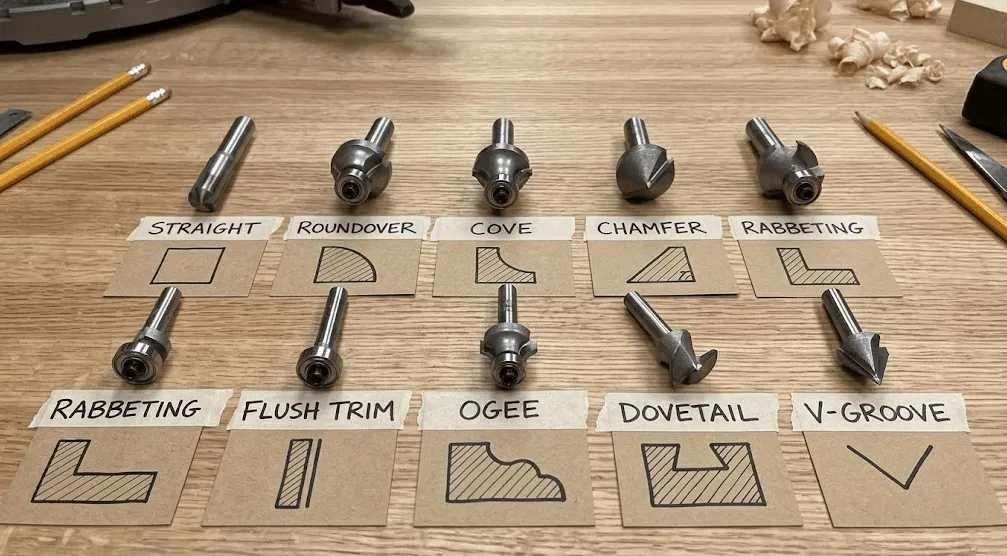
Router bits split into two broad families. Edge-forming bits shape a profile along a board’s edge and usually ride on an integral pilot — a fixed collar or a ball-bearing guide — to control depth of cut. Groove-forming bits cut a channel somewhere other than the very edge and typically need a fence or template to guide them, since there is no edge for a pilot to follow.
Most bits come with either a 1/4” or 1/2” shank. A 1/2” shank flexes less under load, which matters more as the bit’s cutting diameter grows — anything with a wide cutting radius really wants the larger shank and a router that accepts it.
The nine worth knowing
- Straight bits — cut grooves, dados, mortises and simple inlays. The general-purpose bit you reach for most.
- Rabbeting bits — pilot-guided, for cutting a rabbet or shoulder along an edge, commonly for backs, lids and box joints.
- Flush trim bits — even up an edge or copy one board’s profile onto another using a pattern or existing edge as the guide.
- Forming bits — decorative edge profiles: roundovers, chamfers, ogees, coves and beading.
- Multi-profile moulding bits — combine several decorative profiles in one cutter for moulding work.
- Rail and stile bits — cut the matching profiles for frame-and-panel door construction.
- Raised panel bits — the companion to rail and stile bits, shaping the panel itself; these need a table-mounted router given the size of cut involved.
- Dovetail bits — cut dovetail joints, almost always paired with a jig to guide the pattern.
- Veining and V-groove bits — carve lettering and decorative V-shaped channels.
Buying advice
Favour 1/2” shank bits where your router supports them — less flex means a smoother cut, especially in hardwood. Solid carbide or carbide-tipped cutters hold an edge far longer than steel, at the cost of being more brittle if dropped or run into a hidden nail.
For a first set, a five-piece starter kit covering rabbeting, straight, roundover, chamfer and Roman ogee profiles handles most early projects, alongside a three-piece straight bit set sized to match common plywood thicknesses for dados and grooves.